
For an industry built on the ancient triad of needle, thread, and loom, true disruption is rare. Most advancements are incremental—faster machines, new blends of thread. But quietly, without the familiar hum of sewing motors, a technology is fundamentally rewriting the rules of how we join fabrics: Ultrasonic Quilting.
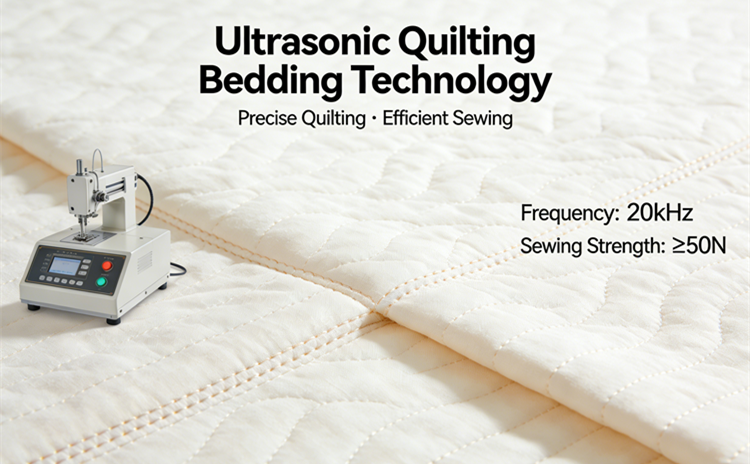
- It Replaces the Core Mechanism: Stitching vs. Welding
Traditional quilting pierces layers and locks them together with thread, creating the perforations themselves. Ultrasonic quilting is a fusion process. It uses high-frequency vibrations to generate precise, internal heat, melting thermoplastic fibers at the molecular level to weld layers into a single, continuous unit.
This eliminates thread consumption, needle breakage, and tension adjustments. It creates a seam that is inherently stronger, more durable, and resistant to fraying and leakage.
- It Unlocks Unprecedented Design and Production Freedom
Ultrasonic horn following a digital pattern, can instantly “jump,” creating isolated, intricate motifs and complex patterns without stopping or restarting a stitch line.
Radical Speed & Simplified Workflow: There is no threading, no bobbin changes, and no color matching, increases output and reduces skill barriers for complex quilting.
- It Enables Sustainable Innovation
The technology favors 100% thermoplastic fabrics. This creates a fully recyclable, single-material laminate bypasses the complex and problematic separation of threads from fabric at end-of-life.
Energy & Consumables: It removes the entire thread supply chain and reduces energy consumption by generating heat only at the precise point of bonding, not across an entire heating element.
- It Creates Entirely New Product Categories and Properties
It can bond fabrics to films, foams, or meshes without compromising their structure, opening doors for advanced composites in automotive interiors, acoustic panels, or wearable technology.
Ultrasonic quilting replaces a mechanical joining principle with a digital, molecular one. It shifts the industry from a subtractive, assembly-based model to an additive, fusion-based model. It unlocks radical design freedom, promotes material circularity, and creates foundational advantages for next-generation textile products.
Learn more: http://www.springtextile.com Or Spring Hometextile video channel: www.youtube.com/channel/UCMCz-yKQMYxA1e2Uscw5PHw Also can contact Tina at: [email protected]